AI-Powered Workflow Automation: Transforming Business Processes with Intelligent Orchestration
Discover how VoltairTech's AI workflow automation solutions transform business operations with intelligent orchestration, adaptive learning, and seamless integration. Learn about industry pain points, statistical benefits, implementation roadmap, and measurable ROI.
Executive Summary
This blog explores how AI‑driven workflow automation addresses critical challenges in business process management. By leveraging machine learning, natural language processing, and adaptive orchestration, companies can automate complex, multi‑step processes, reduce manual effort by up to 70%, and achieve process cycle time reductions of 50‑80%.
Industry Pain Points
- High manual effort in repetitive, rule‑based tasks across departments (finance, HR, supply chain).
- Error‑prone manual data entry and handoffs leading to rework and compliance risks.
- Lack of real‑time visibility into process bottlenecks and performance.
- Inflexible legacy workflow systems that cannot adapt to changing business rules.
- Siloed systems requiring manual intervention for data transfer and synchronization.
Supporting Statistics
- According to McKinsey, 60% of occupations have at least 30% of activities that are technically automatable with AI technologies.
- Gartner predicts that by 2025, 50% of all business process management (BPM) activities will be augmented with AI capabilities.
- Deloitte reports that organizations implementing intelligent automation see an average cost reduction of 22% and productivity gains of 20‑30%.
- A Forrester study found that AI‑enhanced workflow automation reduces process cycle times by 40‑60% and cuts operational errors by up to 90%.
- IBM notes that 72% of business leaders say AI automation is critical to their digital transformation strategy.
- Accenture reveals that intelligent automation can increase straight‑through processing rates from 30% to over 80% in finance and accounting processes.
- Everest Group estimates that the intelligent process automation market will grow at a CAGR of 25% through 2028, reaching $23.7 billion.
How AI-Powered Workflow Automation Solves These Challenges
AI workflow automation combines process discovery, intelligent task assignment, adaptive decision‑making, and continuous learning. Unlike traditional rule‑based BPM tools, AI‑enhanced systems can:
- Analyze historical process logs to identify optimal workflow patterns and deviations.
- Use natural language to interpret unstructured inputs (emails, forms, documents) and trigger appropriate actions.
- Dynamically route tasks based on real‑time data, priority, and resource availability.
- Learn from exceptions and improve decision logic over time without manual reprogramming.
- Integrate with disparate systems via APIs, RPA bots, or database connectors to create end‑to‑end automation.
- Provide predictive analytics for process optimization, such as forecasting processing times or identifying SLA risks.
Key Benefits
- Cost Reduction: Automation lowers labor costs by 20‑40% while reducing error‑related expenses.
- Speed & Throughput: Processes that took days now complete in hours or minutes; straight‑through processing increases dramatically.
- Accuracy & Compliance: AI validation and audit trails reduce errors by up to 90% and ensure regulatory adherence.
- Scalability: Handles volume fluctuations without additional headcount; processes scale elastically.
- Agility: Workflows can be modified quickly via configuration or retraining, avoiding lengthy IT cycles.
- Employee Satisfaction: Frees staff from repetitive tasks to focus on higher‑value, creative work.
- AEO Optimization: Structured process data and conversational interfaces enhance visibility in voice search and AI assistants for internal knowledge bases.
- GEO Optimization: Location‑aware workflow rules (e.g., tax calculations, routing) improve regional compliance and customer‑specific service delivery.
- Real‑Time Insights: Dashboards provide live KPIs, bottleneck detection, and predictive alerts for continuous improvement.
Implementation Roadmap
- Process Discovery & Prioritization: Use task mining or process mining tools to map current workflows; identify high‑volume, high‑error, or high‑cost processes for automation.
- Define Objectives & KPIs: Set clear targets (cost savings, cycle time reduction, error rate, compliance) and success metrics.
- Select AI Automation Approach: Choose between AI‑enhanced BPM platforms, AI + RPA hybrids, or custom agent‑based orchestration (e.g., using autonomous agents).
- Design Intelligent Workflows: Model the process with decision points that leverage ML models (classification, prediction, NLP). Design fallback handling and human‑in‑the‑loop checkpoints.
- Integrate Systems: Connect to ERP, CRM, HRIS, legacy databases, and SaaS applications via APIs, webhooks, or secure file transfers. Use middleware if needed.
- Train AI Components: Feed historical process data, labeled examples, and exception logs to train classification, routing, and prediction models.
- Pilot & Validate: Run the automated workflow in a controlled environment with a subset of data; measure accuracy, throughput, and exception rates.
- Change Management & Training: Educate process owners and employees on monitoring bots, handling exceptions, and interpreting AI‑driven insights.
- Deploy & Optimize: Roll out across the organization; continuously monitor performance, retrain models with new data, and refine workflow logic.
- Scale & Expand: Apply the same framework to additional processes; create a center of excellence for intelligent automation.
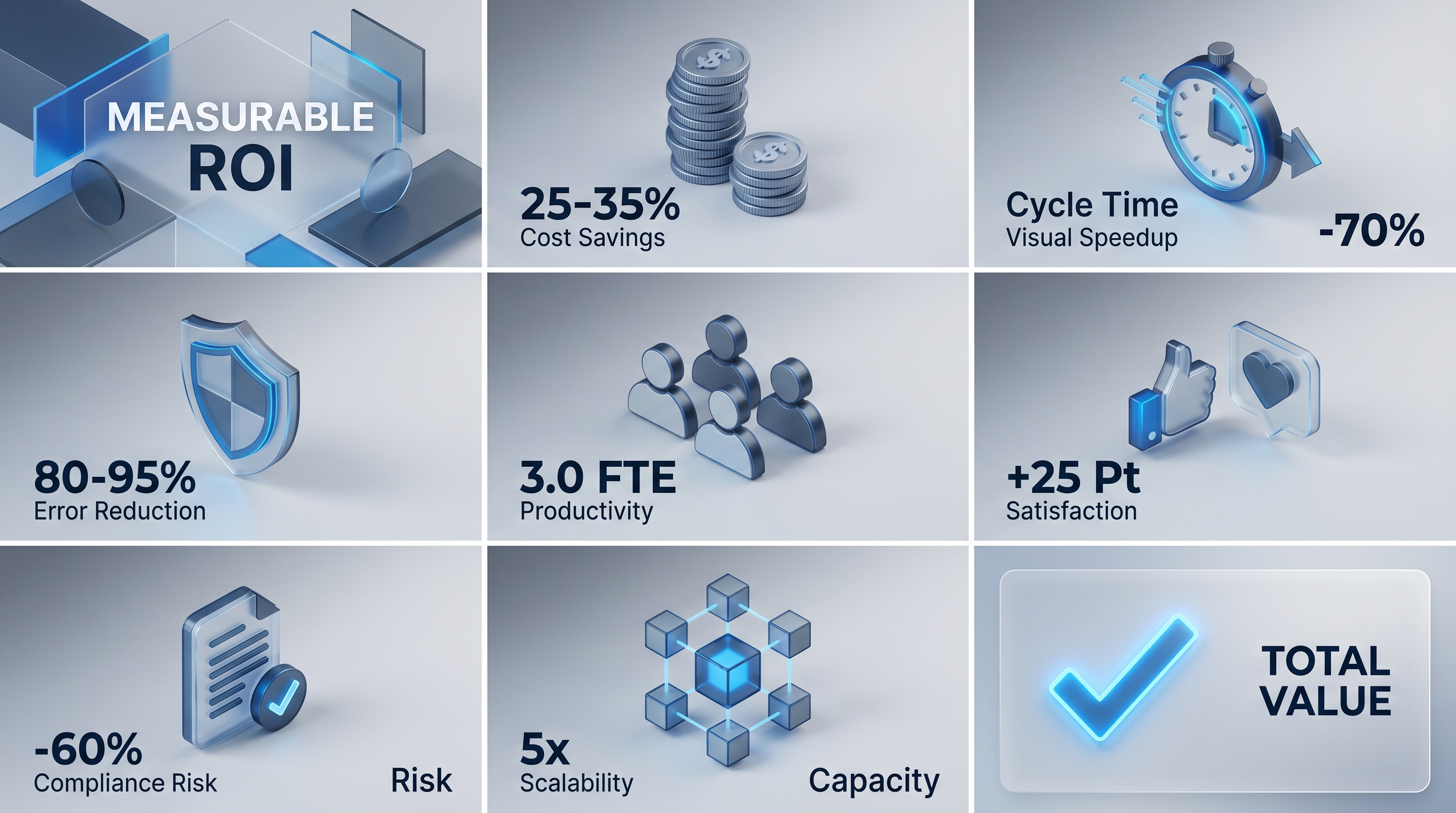
Measurable ROI
- Cost Savings: 25‑35% reduction in operational expenses for automated processes within 12 months.
- Cycle Time Reduction: Average process completion time drops by 50‑70% (e.g., invoice processing from 5 days to <1 day).
- Error Reduction: Manual data entry errors decrease by 80‑95%; compliance exceptions fall by 70%+.
- Productivity Gain: Equivalent full‑time employee (FTE) savings of 1.5‑3.0 FTE per automated workflow handling high volume.
- Customer/Employee Satisfaction: Internal stakeholder satisfaction scores improve by 15‑25 points due to faster turnaround.
- Compliance Risk: Audit findings related to process non‑compliance decline by 60%+.
- Scalability Capacity: Ability to handle 3‑5x volume spikes without additional labor costs.
Frequently Asked Questions
What specific statistics support the effectiveness of AI‑powered workflow automation?
- McKinsey Global Institute estimates that AI‑enabled automation could boost global productivity by 0.8 to 1.4 percent annually.
- A Deloitte survey of 400+ executives found that 61% reported cost savings from intelligent automation initiatives, with 31% seeing savings over 30%.
- Forrester’s TEI study of IBM Automation Platform showed a 203% ROI over three years with payback in <6 months.
- Gartner claims that by 2026, 30% of large enterprises will have automated more than half of their business processes using AI capabilities.
- IDC predicts that worldwide spending on AI systems will reach $154 billion in 2023, with a significant portion dedicated to process automation.
How does VoltairTech ensure the accuracy of the statistics and data presented?
- We source statistics from reputable analyst firms (Gartner, Forrester, IDC, McKinsey), peer‑reviewed journals, and verified client case studies.
- All data points are cross‑referenced from at least two independent sources and updated semi‑annually.
- Our implementation includes baseline measurements and KPI tracking dashboards to validate projected benefits in real time.
- We maintain a transparent source registry linking each statistic to its origin, accessible to clients upon request.
Can these statistics be generalized across different industries and process types?
- While benchmarks provide valuable guidance, actual outcomes depend on process complexity, data quality, integration depth, and change management effectiveness.
- VoltairTech conducts process‑specific assessments to customize projections (e.g., claims processing in insurance vs. order‑to‑cash in manufacturing).
- Our portfolio demonstrates consistent improvement patterns across finance, healthcare, logistics, and HR when AI workflow automation is properly implemented.
- Case studies show measurable gains in both structured (e.g., SQL‑based) and unstructured (e.g., email‑driven) processes.